Isometric 3D render of my workspace at night: me at an L-shaped desk with two monitors, a whiteboard, posters and a city view through the window

Modeled, lit, and rendered by me in Blender.

Explore the Room
Photo of Praneet Bala The same photo as Canny edges Pixel-art version of me Me as a 2D Gaussian splat Face with pose-estimation keypoints
RGB

Praneet Bala

I build systems that see, reconstruct, and reason about the 3D world.

3D reconstructionHuman motionWorld models

  • Ph.D., Computer Science, University of Minnesota, Twin Cities
  • Saint Paul, MN

I recover 3D structure and motion from cameras, grounded in multi-view geometry. I did my Ph.D. at the University of Minnesota, advised by Dr. Hyun Soo Park, Dr. Jan Zimmermann, and Dr. Stephen J. Guy.

My thesis built a 62-camera capture system, used geometric consistency to learn 3D pose with minimal supervision, and lifted single-view video into forecastable 3D motion.

Today I’m extending that to egocentric perception: reconstructing a scene with Gaussian splatting, fitting SMPL-X bodies within it, and recovering a person’s own view of the world.
Projects

Exo-to-Ego World Modeling
Reconstructs a metric 3D scene with Gaussian splatting from a calibrated multi-view rig, fits SMPL-X body models within it, and localizes a head-mounted ego camera to recover the subject’s own view.
Discussion on LinkedIn →
3D body motion forecasting teaser
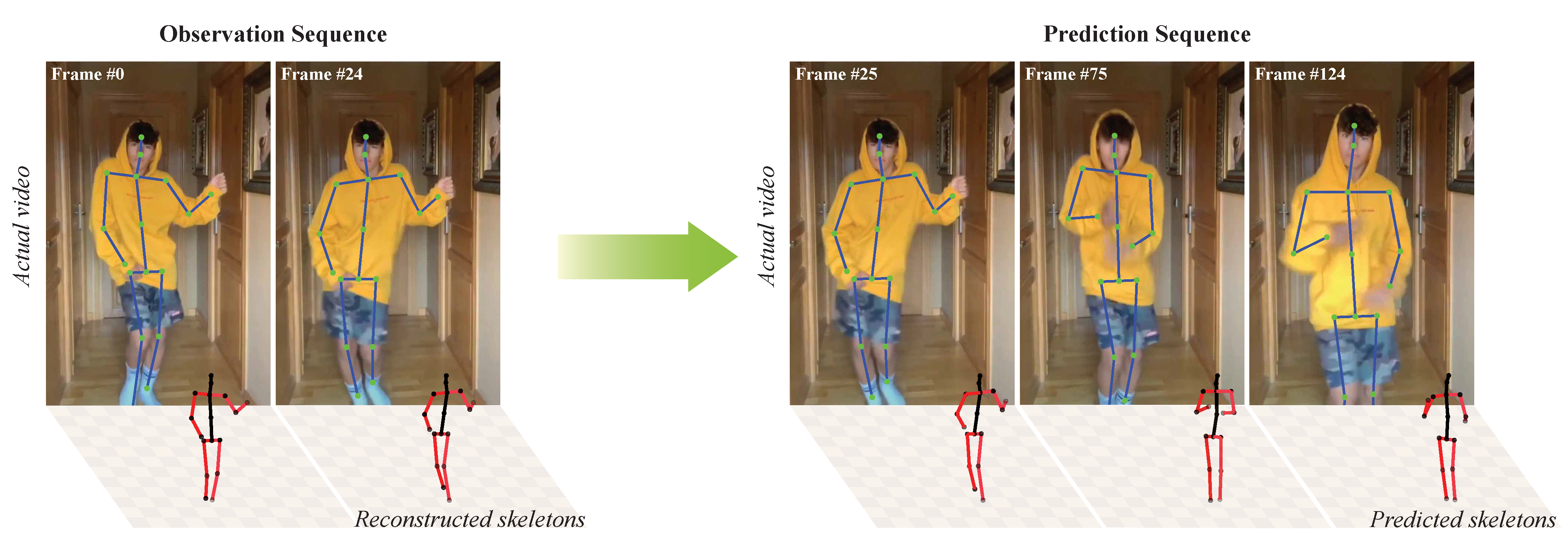
Learning to Forecast Domain-Aware 3D Body Motion
Self-supervised framework that jointly learns 3D motion reconstruction and future motion generation from 2D domain videos. Uses a spatiotemporal transformer (PoseFormer) for 2D-to-3D lifting and a latent diffusion model (BeLFusion) for long-term forecasting. Achieves competitive ADE/FDE on Human3.6M and outperforms baselines on cross-domain MPI-INF-3DHP without 3D domain supervision.
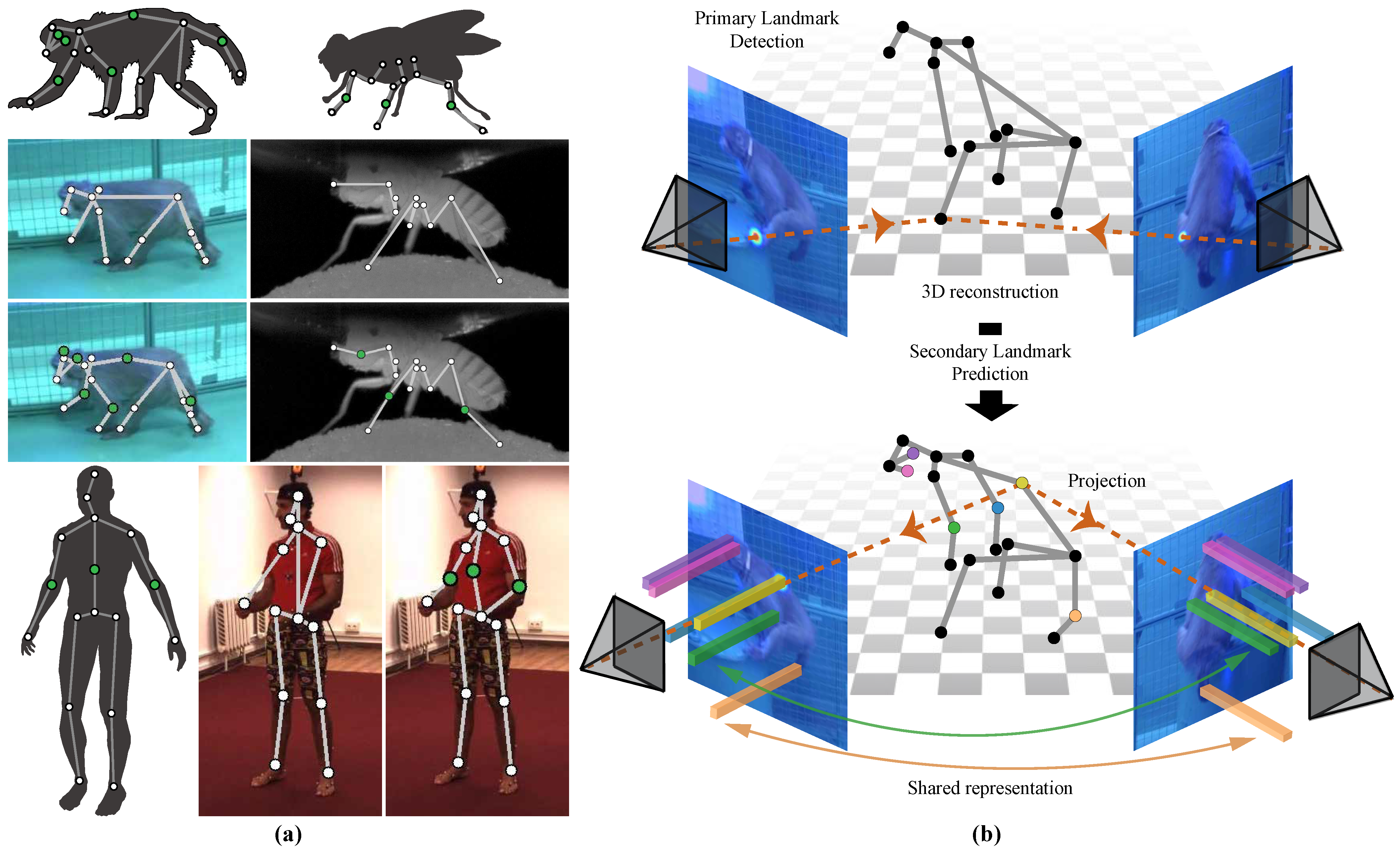
Secondary landmark detection teaser
Self-supervised method using 3D representation learning and multiview contrastive learning to detect anatomically consistent secondary landmarks without manual annotation. Uses Procrustes-normalized triangulation and twin convolutional pose machines to enforce geometric and semantic consistency across views. Achieves PCKh@0.5 of 0.75 on OpenMonkeyPose, validated across macaques, humans, and flies with less than 10% labeled data.
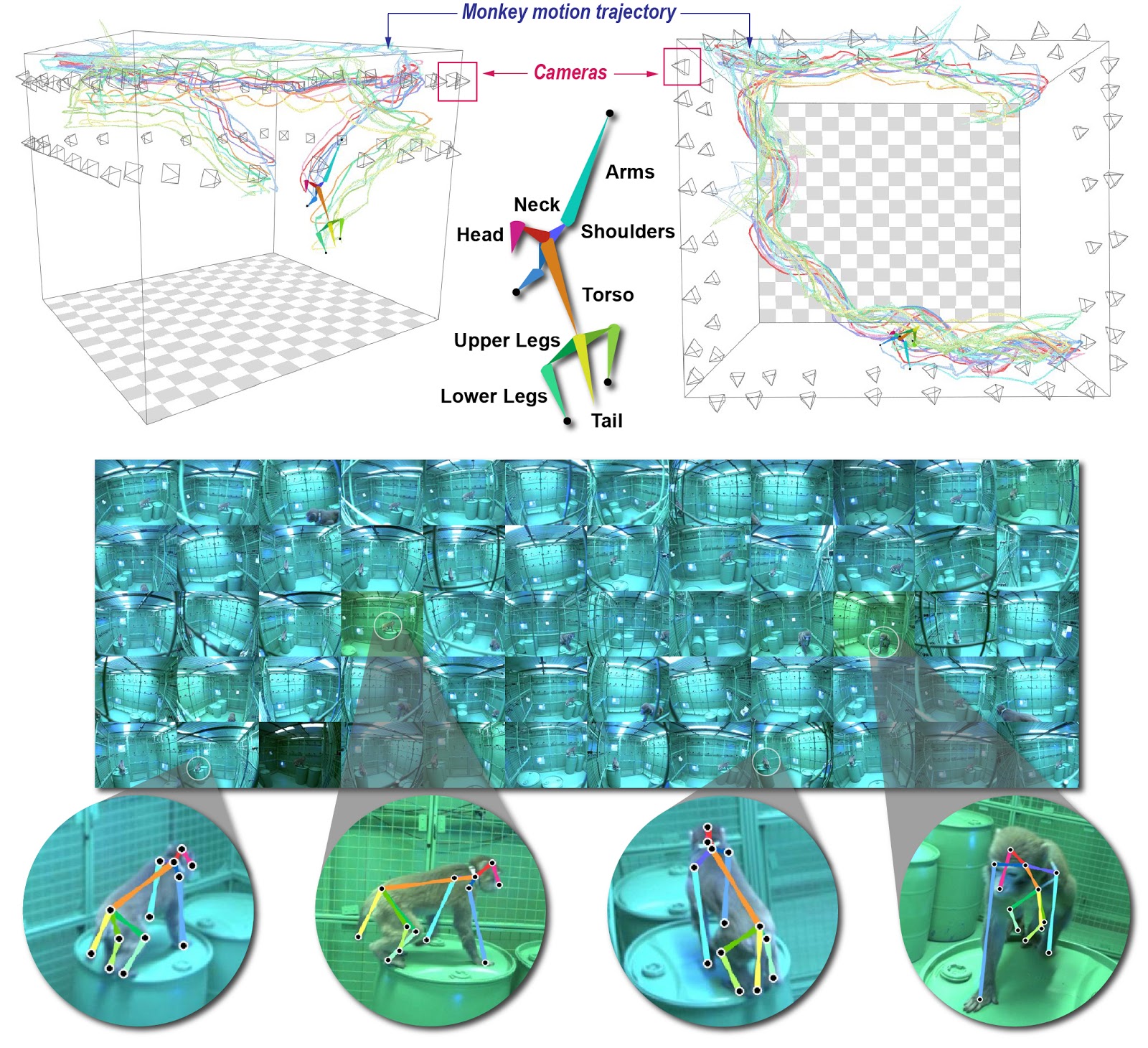
OpenMonkeyStudio teaser
Engineered a 62-camera markerless motion capture system for high-fidelity 3D body tracking of freely moving macaques in unconstrained environments. Built an end-to-end pipeline spanning multi-view calibration, 2D pose estimation, and 3D triangulation. Released a public dataset of 195,228 annotated pose frames across 13 body landmarks and diverse activities.
Tool
Pose Keypoint Visualizer
A browser-based 3D viewer for human and animal pose keypoints. Supports drag-and-drop JSON files, animated playback, skeletal connections, motion trails, and multiple themes.

Note: the online version supports JSON files only. NPY conversion requires running the tool locally.

Dimension gameplay: the player runs down a red-lit 3D corridor toward an emergency exit, with a countdown timer
Game jam
Dimension
A puzzle game in which reality is a file system: renaming a file in a terminal changes the world around you. The player moves between line, plane, and 3D perspectives to escape a facility. Built in four days with the ThunderOps team for the 2026 Epic AI MegaJam.

My role: world building (map design and creation), character design and animation, and the puzzles for the final level.

View all projects →

Publications

Bala et al., “Learning to Forecast Domain-Aware 3D Body Motion by Watching Single-View Videos.” Manuscript in preparation.

News

Service

Reviewing
Invited Talks
Automated Markerless Pose Estimation in Freely Moving Macaques with OpenMonkeyStudio
UMN Center for Neuroengineering seminar series
UMN Visual Computing & AI seminar series
Teaching